


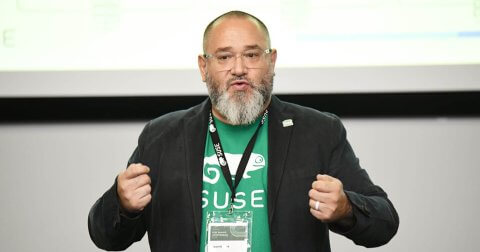
SUSE’s Lionel Meoni explains how embedded intelligence, long-term lifecycle support, and transparent security are redefining how Middle East enterprises modernise at scale.
Enterprises across the Middle East are accelerating their AI adoption, and with this shift comes the need for infrastructure that is intelligent, secure, and built to scale. In its latest release, SUSE Linux Enterprise Server (SLES) 16 positions itself as a foundational platform for this new era—embedding Agentic AI directly into the operating system, ensuring transparency through reproducible builds, and offering one of the industry’s longest lifecycle commitments.
Lionel Meoni, Senior Manager Solution Architects CEMEA & Domain Solution Architects EMEA, SUSE, spoke to Tahawultech.com about how SLES 16 is redefining enterprise IT management. Meoni discusses its AI-ready architecture, long-term support model, supply-chain assurance features and the growing partner ecosystem enabling organisations to modernise with confidence—without vendor lock-in.
Interview excerpts:
How does the integration of Agentic AI and the Model Context Protocol (MCP) in SLES 16 transform how enterprises manage and automate their IT infrastructure?
The integration of Agentic AI and the Model Context Protocol (MCP) in SLES 16 shifts enterprise IT from manual management to an intelligent, autonomous model. Instead of adding AI tools on top, SUSE embeds intelligence directly into the operating system, allowing AI agents to detect, troubleshoot, and automate tasks such as configuration fixes, performance issues, and patching using real-time system context. MCP connects AI models to existing tools and data through open standards, ensuring flexibility and avoiding vendor lock-in. Together, Agentic AI and MCP enable natural-language operations, automated root-cause analysis, and context-aware automation, all with governance and human oversight built in. Overall, SLES 16 becomes an AI-ready platform that reduces manual effort, improves efficiency, and scales easily across hybrid, multi-cloud, and edge environments.
SLES 16 is positioned as the first “AI-ready enterprise Linux platform”. What does this mean for CIOs and CTOs looking to modernise without being locked into a specific ecosystem?
SLES 16 being an “AI-ready enterprise Linux platform” means AI is built into the foundation, not added on top. For CIOs and CTOs, this delivers modernisation without locking them into any ecosystem. The platform supports GPUs, containers, and hybrid cloud while consolidating traditional and AI workloads on one system. Its real advantage lies in embedding agentic AI directly into Linux management, enabling faster, more adaptive, and automated operations. Because SLES 16 follows open standards like MCP, it stays interoperable with any AI model or provider, ensuring long-term flexibility and avoiding vendor lock-in. In short, SLES 16 modernises existing workloads, enhances DevOps/AIOps automation, and provides a single, open, future-proof foundation for AI adoption.
With a 16-year lifecycle commitment, SUSE is promising long-term stability for mission-critical workloads. How does this extended support translate into business value and cost efficiency for regional enterprises?
SUSE’s 16-year lifecycle gives Middle East enterprises rare long-term stability, predictable costs, and stronger ROI. Each Service Pack offers 2 years of General Support plus 3 years of Long-Term Support, meaning organisations can run up to five years without a forced minor upgrade—significantly reducing disruption and operational overhead. For sectors like banking, utilities, telecoms and government, this extended lifecycle aligns with multi-year transformation plans, avoids unplanned migrations and allows hardware, software and talent investments to stretch further. Fewer upgrades lower total cost of ownership, reduce downtime and simplify budgeting.
“Combined with SLES 16’s AI-driven automation, enterprises can run larger, smarter environments with smaller teams—an important advantage in a region where specialised skills are in short supply.”
The new release also highlights reproducible builds and EAL4+ level security certifications. How do these features strengthen trust, transparency, and compliance for organisations adopting open-source infrastructure?
SLES 16 strengthens trust by giving enterprises full transparency into what they run. Reproducible builds let customers verify the OS themselves by rebuilding it from source, eliminating doubts about tampering or hidden code. SBOMs provide a complete inventory of components and dependencies, helping with compliance and enabling faster vulnerability response. With EAL4+ Common Criteria certification, SUSE adds independent validation of its security and supply-chain integrity—crucial for government, finance, and telecom sectors. Together, these capabilities create a transparent audit trail aligned with regional sovereignty priorities, making SLES 16 a strong fit for regulated, high-assurance environments.
How do you see SUSE supporting partners and customers in building a secure, scalable, and future-ready IT foundation?
SUSE is positioning SLES 16 as the secure, scalable base for AI across the Middle East. It is expanding its partner ecosystem with training and certification so regional integrators can deploy AI-ready, compliant infrastructure. Its “run anywhere” model supports hybrid, multi-cloud, and edge, enabling workloads to scale from data centres to energy and telecom sites. SUSE also guides enterprises in AI-operations maturity with governance, MCP-based toolchains and skills development. Backed by reproducible builds, certification, and long-term support, SLES 16 provides a trusted foundation for sovereign cloud and regulated sectors. As AI moves into production, SUSE offers reference architectures and migration tools that ensure performance, portability, and freedom from vendor lock-in.