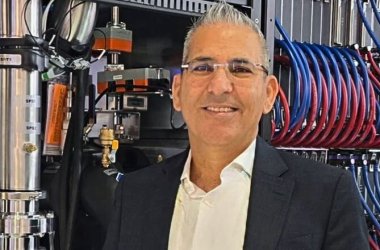



CNME Editor Mark Forker sat down with Professor John Lee Chi-Kin, President of The Education University of Hong Kong, (EdUHK) to learn more about how he thinks AI is going to impact the global education system, the challenges facing both teachers and students in terms of how they can harness the technology – and why the Middle East needs to strike the right balance when it comes to aspirations over improvement and employability.

Professor John Lee Chi-Kin is the President of The Education University of Hong Kong (EdUHK) – and he is a widely revered and respected global leader in teacher education, educational policy and research.
Professor Lee attended the World Government Summit 2026 in Dubai as part of a whistlestop tour of the UAE and Oman earlier this month.
He is proactively engaging with academic institutions and universities across the UAE and Oman as part of his efforts to support what he described as ‘future-ready’ education systems.
CNME managed to secure an exclusive interview with Professor Lee during his time in Dubai.
The main topic down for discussion was rather inevitably that of AI, and its impact on how education is going to be dispensed in the future.
The education industry isn’t immune to fear when it comes to the advent of AI technology in their processes, policies and systems.
So, naturally the conversation began by examining how AI can really change the core principles that have always existed in the education space.
Professor Lee said that conversations around the impact of technology in classrooms was not something new.
“I have attended many educational conferences over the last few years, and typically there are questions over what the future role of teachers will be in a world that is driven and dominated by technology. For example, will one-to-one tutoring now become a thing of the past considering we have Open AI models like ChatGPT that can provide students with access to information within seconds, where they can interact with ChatGPT like it’s a teacher or assistant. These are all legitimate questions to ask. Another area is related to the impact AI will have on future research in education. Research-led teaching is one of the most important areas where AI will have not only short-term impact, but probably medium-term impact too,” said Professor Lee.
Yet Lee highlighted the limitations that also come with a lot of the Open AI public models and these need to be recognized.
“The human-AI interaction now is extremely interesting, because AI has been democratised and very few people are not using AI in some capacity. However, it’s important to remain cognisant of the fact that we are talking about different human talents with different values and perspectives interacting with large AI databases. Yet we are hyperaware of the fact that the database generated by algorithms is drawing on information and making predictions that in many cases will have certain limitations. At the end of the day, it goes back to the quality of the data that is driving AI output,” said Professor Lee.
Professor Lee then moved the dial of the conversation towards defining the actual role of a teacher.
He reiterated that AI can’t deliver real human interaction that is at the core of what teaching is all about.
“I think some of the key questions that as educators we need to ask are around literacy and the role of teachers in a society that is increasingly becoming underpinned by technology. I’ve been working in the field of education for a long time, and there’s no doubt that the power of AI is real. Yet it’s important to also acknowledge and highlight that the role of teachers is fundamentally different: it is based on human interaction. It is all about cultivating and nurturing talent, inspiring and motivating future leaders. Teachers don’t just transmit knowledge; they create an environment that allows creativity and learning to flourish,” said Professor Lee.
With the role of a teacher clearly defined, Professor Lee pivoted the discussion to examine how teachers need to effectively use AI to enhance their ability to inspire and motivate their students.
But what should they teach?
What are the most important fundamentals?
“I think teachers need to embrace AI and not view it as a threat. They need to leverage the capabilities of the technology to effectively incorporate it in the way they teach. That must be done in an ethical way, and the same applies to students using AI to learn. There has been a lot of focus on self-regulated learning that also applies to a teacher’s point of view about what to teach. AI is a powerful tool, but what are the most important things to teach? That can be a philosophical question for many educators, who will inevitably have differing views. What knowledge is the most important to transmit to the next generation? Personally, I think you must start with the classics, the most valuable parts of different civilisations and societies that we must preserve and conserve, and I think the classics are a good yardstick to start with,” said Professor Lee.
Professor Lee added that local relevance must also play a key part in determining the contextualisation of knowledge and comparing that with the contextualisation of applying AI into education systems.
There have been increasing calls globally to reform curriculum in many countries, with those advocating for change saying current education systems are no longer fit for purpose.
For example, many countries reward rote learning and memorisation. Yet many people believe there are plenty of different educational models that academic institutions can adopt to implement change and reform.
Can AI help countries transform their curriculum?
Professor Lee believes it can.
“Look I think there is a universal consensus from many educational researchers that a significant number of countries do need to review their curriculum and ask an uncomfortable question: does the current curriculum unleash the potential of every student, or just the ones that can learn something off by heart? I think we need to make a very important decision: what should we memorise, and what should we not memorise? Educators need to make that distinction, but it goes back to our conversation around what sort of AI do educators use, are the datasets reliable? AI can help us, but there needs to be governance and structures built around it. First, we need a foundational layer. How do we use AI for inquiry and challenging questions, sometimes in the field we call these ‘grand questions’. AI needs to be used to help human beings and improve humanity. We all know how powerful education is, and if AI can be implemented in a way that improves the overall system, then we need to encourage its adoption,” said Professor Lee.
The UAE and other nations across the Gulf have made no secret of their desire to be a global leader in AI.
But we know that when it comes to becoming an AI powerhouse globally, you need talent.
How can government across the Middle East carefully balance innovation with regulation when implementing AI into schools and universities.
Professor Lee said that ‘balance’ was the key word.
“Balance is so important, but it’s not easy to achieve. First, you need to balance innovation with tradition, and every system has their own strengths, and you need to respect, treasure and conserve those traditions. Countries have different cultures, traditions and perspectives and that is valuable. However, what I think is critically important is the balance between employability and the aspiration for improvement. You can be brave and have the courage to dream and cross boundaries through innovation, but we must start looking for talented people who are risktakers on one hand but also possess the ability to reimagine the future. I think these are the talents that are needed across society,” said Professor Lee.
Professor Lee said education systems across the Middle East must start creating those types of talents and again reiterated the importance of increasing ‘employability’.
“The workplaces of the future have new demands and expectations, so we need to start creating the talent that industry needs. Education systems need to increase the employability of every student under their watch. The curriculum does have to change to do that, but again, like we said earlier that’s not a straightforward process. The curriculum is all about the combination of time and space. With the advancements in technology, we can learn in different time zones, so you don’t necessarily need a fixed timetable, and we can all study and learn outside of classrooms and beyond schools, so that’s how we configure it and that’s how we can go about reshaping curriculums. At the end of the day, when you talk about curriculum, instruction and learning, you must remember that we need to focus on three aspects. The content, what do we learn, then the aspect of cultivating teachers, how do we train teachers for the future, and lastly is all about context,” said Professor Lee.
Professor Lee concluded a brilliant interview by calling for all governments globally to work together and share one unified vision.
“We need less competition and more collaboration. We need greater harmony, and a shared understanding of what is required for our futures. How can we all work together to create a better future for all? I think AI can help us close the gaps in terms of training and enhancing economic development. There are huge opportunities with AI, but there is lots to be figured out in order for us to really harness its capabilities, and for us to do that, then we need to work together,” said Professor Lee.