



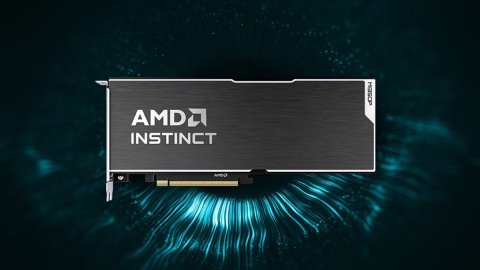
 New Instinct MI350P PCIe GPUs are designed to help organisations run AI workloads on standard air-cooled infrastructure.
Enterprise AI adoption is accelerating, but many organisations are finding their existing infrastructure under pressure. Cloud-based AI can offer flexibility, yet it may also create concerns around data privacy, sovereignty, latency and unpredictable costs. Building dedicated AI infrastructure, meanwhile, can demand major investments in power, cooling and specialised GPU platforms.
AMD is addressing that challenge with its new AMD Instinct MI350P PCIe GPUs, designed to help enterprises deploy AI workloads within existing data centre environments without significant infrastructure redesign.
The new accelerator cards come in a dual-slot PCIe form factor and can fit into standard air-cooled servers already deployed across enterprise environments. Organisations can therefore introduce AI acceleration without overhauling racks, cooling systems or power distribution setups.
According to AMD, the Instinct MI350P GPUs are aimed at enterprises preparing for the next phase of AI adoption, including inference workloads, retrieval-augmented generation pipelines and emerging agentic AI applications.
Built for practical AI deployment
The PCIe-based architecture gives organisations an alternative when they need more AI compute power than CPUs alone can provide, but are not yet ready to invest in large-scale GPU accelerator clusters.
AMD said the GPUs can be deployed in air-cooled systems supporting up to eight accelerator cards, making them suitable for small, medium and large AI models within enterprise data centres. The company is also focusing on performance, cost efficiency and faster deployment, three priorities increasingly shaping enterprise AI investment decisions.
Key specifications include up to 2,299 teraflops of estimated performance, peak performance reaching 4,600 teraflops using MXFP4 precision, 144GB of HBM3E memory and memory bandwidth of up to 4TB/s. The cards also support AI precision formats including FP8, MXFP8, MXFP6 and MXFP4. Lower-precision formats help improve throughput and inference efficiency, while reducing pressure on power and cooling resources.
Open ecosystem approach
AMD continues to position openness and interoperability at the centre of its enterprise AI strategy.
The MI350P GPUs integrate with widely used AI frameworks and tools, including Kubernetes GPU Operator, AMD Inference Microservices and PyTorch support. AMD is also offering its open-source enterprise AI reference stack to partners without licensing fees. The move is designed to simplify deployment and help reduce operating costs for enterprises building on-premises AI environments. The company said the approach enables organisations to migrate inference workloads with minimal code changes while avoiding ongoing usage-based cloud AI charges.
Scaling AI without rebuilding from scratch
Enterprise AI is moving from experimentation to production. Technology leaders now need infrastructure that can support AI workloads efficiently while staying aligned with cost, compliance and data control requirements. The AMD Instinct MI350P PCIe GPUs are positioned to bridge that gap by allowing organisations to run more models, support more users and scale AI workloads inside existing data centres. For enterprises looking to expand AI capabilities without a full infrastructure overhaul, AMD’s latest GPU cards offer a practical route to on-premises AI deployment.