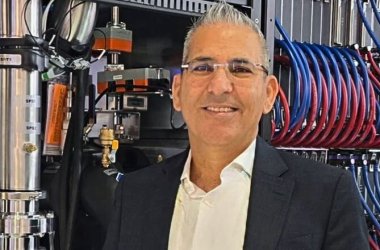



CNME Editor Mark Forker spoke with Mary O’Leary, Tax Policy and Technology Expert at DataTorque, to find out how a newly formed UN Tax Subcommittee has been designed to ensure that developing nations have their voices heard and are not left lagging behind in the AI arms race.

The last time I sat down for a conversation with Mary O’Leary, it was November 2020.
At the time, O’Leary was working for Vizor Software and was based in Paris.
2020 was a year of seismic change, triggered by the global COVID-19 pandemic that engulfed our world in March of that year.
In the time that has passed since we last spoke, quite naturally, a lot has changed.
The global pandemic ended.
Vizor Software was acquired by BearingPoint Reg-Tech in 2021.
In February 2022, O’Leary moved to one of the biggest professional services companies in the world in the form of EY.
She was appointed as a director and subsequently relocated to Dubai.
In August 2025, she was appointed as the Tax Policy and Technology Expert at DataTorque.
Despite all the change, one thing has remained constant, and that is the fact that Mary O’Leary is a tour-de-force in the world of tax, technology, and digital transformation.
This was further evidenced following her appointment onto a newly formed UN Tax Subcommittee, that is primarily focused on how AI can be used more effectively by tax authorities in developing countries.
And that’s where we kickstarted our conversation.
The primary aim of the new UN Tax Subcommittee is to give smaller nations a stronger voice at the top table.
“The mandate for this subcommittee was driven by the G7 and G20, and they are at the forefront of seeing how big an impact AI is having on industries and economies globally. However, ultimately, they want to ensure that the gains and the spoils of AI are equally shared, regardless of the size of your GDP. So, predominantly this subcommittee is focusing on developing countries in the emerging south. The UN Tax Committee was formed in 2023, and it was designed to give developing countries a greater voice at the table on international tax policy,” said O’Leary.
O’Leary disclosed that earlier in her career she had worked for the OECD for 6 years – and highlighted how they are often criticized for prioritizing the interests of larger economies, which are predominantly the 38 countries that form the membership of the OECD.
“Developing countries are invited to the OECD meetings, but their voice may not necessarily be fully reflected when new policies are published. I think given the prevalence and power of AI and the rapid speed of change, it is crucial that developing countries are not left behind in all the great things that AI can bring for tax administration,” said O’Leary.
O’Leary said that the demand for change is palpable across the developing nations and stressed that AI can empower tax administrators to do more with less.
“In developing countries there is a massive appetite to promote domestic resource mobilization, as opposed to giving aid to upskill, to give these countries a chance to be self-serving in guaranteeing their own revenues, be it through tax collection or trade. It is so important to arm these tax administrators with the tools to increase their efficiency, because so many of them are badly resourced, so if AI can be deployed to do the work of 10 tax officials, then that’s a win-win for everybody,” said O’Leary.
However, as O’Leary pointed out, the tax industry hasn’t been immune to technological change.
“I think there has been a wave of digitalization changing the tax function for the last while, we have been embracing this sort of new era of optimization for a few years. When I began my career we had paper returns, and then we pivoted towards having 20 Excel tabs open on your laptop, and then we moved to software, and now we are in this new world of AI, where essentially, AI agents are going to do a lot of that grunt work for you,” said O’Leary.
The conversation then pivoted towards the impact the implementation of AI is going to have in terms of the way tax administrators tackle things like compliance and reporting, compared to a few years ago.
Again, O’Leary said new technologies are reshaping traditional norms, but with a lot of human oversight.
“Quite often tax doesn’t have a massive voice because they are a downstream consumer of data. Generally, they are in operations as opposed to other industry verticals when it comes to the topic of technological change. However, what we’ve seen from companies, and particularly those based in the Gulf, because they are real leaders when it comes to emerging tech, is the fact that there is an AI-driven policy cross-firm, so everyone is encouraged to get onboard and training is provided. Some of that training includes what sort of prompts you should use on Claude, or Co-Pilot to get accurate tax advice. Do you blindly rely on the output? Absolutely not, but it’s AI-driven, but it’s human reviewed, enforced, and ultimately signed off on at a human level, and that’s what we’re seeing on the tax function for big companies,” said O’Leary.
In terms of how AI is transforming traditional processes for tax authorities, O’Leary conceded that things are typically a bit slower due to institutional reforms, and the fact that there’s obviously the geopolitical element that they need to contend with.
However, she stressed that there has been massive forward movement, and this was further evidenced by a report commissioned by the OECD.
“The OECD conducted a comprehensive report on digitalization, and they estimated that around 80% of tax authorities are using some form of AI in their operation. When you talk about AI there are some misconceptions that it is just a chatbot, but that’s not what we’re talking about here. We are talking about being able to train algorithms with enough data, so they can start to predict future behaviors. Now that’s very interesting from a tax perspective because if we start thinking about tax avoidance, tax evasion, or fraud, we obviously want to be able to predict this from happening before it does, and that’s where the value really is. When fraud has been committed and there’s an audit open, then it can be quite cumbersome in terms of time, money and resources on both sides, but if you can try and preempt that, then it’s powerful. For example, if a large multinational files their tax returns, AI technology can give them a prompt to ask did you make that deduction, have you properly filled that in? Essentially, it is all about putting the taxpayer at the heart of compliance, and getting the compliance right at the first attempt, and that is where the real value lies,” said O’Leary.
O’Leary said that the questions she is asked around the implications of AI are universal.
There are two main challenges, and I get the same questions asked by tax authorities in some shape or form everywhere I go. The first one is the declaration that they don’t want to host anything in the cloud because of cybersecurity concerns and data sovereignty for tax, and then the other one is the question of is AI going to take my job? Is AI going to take your job if you don’t embrace it, then quite possibly it will. However, if you upskill and harness the power of AI to leverage your position then that’s ultimately the place that you want to be in,” said O’Leary.
One of the biggest issues with AI, regardless of what industry vertical you operate in has been the high failure rate.
1 in 4 projects don’t leave the pilot phase.
The same issues apply to the tax sector, but O’Leary did say that quantifiable results are emerging with AI deployments when it comes to risk.
“At the end of the day, AI can do pattern recognition and anomaly detection so much faster than a human, and so much more accurately with the quantum of data we’re now seeing around tax. If you’re sitting at the head of a large multinational corporation in this region, then one of your main objectives is to be compliant. The era of tax evasion is gone. The BEPS project spearheaded by the OECD has stopped that. I feel that in this region especially we are very privileged and lucky with all the things that we have access to, be it education, healthcare, or the workforce, it’s a very safe environment and people want to conduct business here, and regulators want to make it business friendly. I think AI can facilitate that in terms of transparency and in terms of easing compliance. It’s making everybody’s job smoother and easier, and from my conversations with regulators and tax authorities they are always talking about AI as a journey. They also see the benefit of securing what they would describe as a few ‘quick wins’ to validate AI, and risk and compliance is an area where you can get those quick wins if you deploy AI in the right way,” said O’Leary.
O’Leary first entered the tax domain over 20 years ago, and understandably the landscape has changed considerably within that time.
There is a lot of talk around how AI will end entry-level jobs, but when asked how AI will change things for tax professionals starting out, O’Leary conceded new skills are required, but the fundamental principles of the job have not changed.
“I believe that the principles are the same, and the concepts of tax have been evolving for quite some time now considering the international dynamic. I think there has been a shift in terms of the operationalization and putting all these new tax laws into practice, be it compliance or advisory. To be honest, I’d be so happy if I was starting my career now and not having to do the amount of legwork that was required when I started out over 20 years ago. I think the skill mix is certainly a little different, I mean if you’re a tax advisor then clients are going to expect you to be a strategic business advisor, and that probably wasn’t the case a couple of decades ago. They fully expect you to understand their business. If AI can remove a large chunk of the due diligence you have to do and all the back and forth with tax authorities can be outsourced to AI, then that’s fantastic as that gives you time, and enables you to be more valuable for your client. At the end of the day your network is key, and people want to work with people they get on with, and that’s not going to be an AI agent,” said O’Leary.